Summary
Most AI video generators allow commercial use on paid plans, but IP indemnification is limited to Google Cloud, Runway Enterprise, Luma Enterprise, Adobe and the MiniMax API (October 2026).
- Runway’s standard terms and Kling’s consumer terms allow training on your content; Runway Enterprise prohibits it.
- MiniMax H3 open weights exclude the US, EU, UK and South Korea.
- LTX requires AI-content disclosure; the EU AI Act adds labeling duties from August 2, 2026.
 What Are Your Ideas Today?
Commercial-use rights, copyright protection, training policies, and AI disclosure requirements for Veo, Kling, Seedance, Runway, MiniMax, and other video generators.
Your client wants a 15-second AI-generated commercial. The footage looks good, the deadline is covered, and the budget works. Then someone asks whether you’re legally allowed to use the video in advertising.
The answer depends on more than the AI model.
We examined the commercial-use policies and licensing agreements of 10 AI video model families, including models available through Everypixel and major alternatives.
Can you use AI-generated video commercially? Yes, in most cases. But permission to publish an AI video doesn’t necessarily mean the provider won’t train on your footage, that you own an enforceable copyright, or that you’re protected if someone files an infringement claim.
Some licenses introduce less obvious restrictions. The MiniMax H3 open-weights license, for example, excludes the US, EU, UK, and South Korea. LTX requires AI-generated content disclosure. Runway’s standard terms allow model training on user content, while its Enterprise agreement prohibits it.
Here’s what each license allows and what you should check before delivering AI-generated video to a client.
What to Check Before Using AI Video for Commercial Work
Four questions determine whether a model is suitable for a commercial project.
1. Does your plan allow commercial use?
Some providers reserve commercial rights for paying customers. Kling allows commercial use under its paid membership terms, while Runway permits it across its standard plans. With open-weight models, permission depends on the model license rather than a subscription.
2. Can the provider train on your content?
This matters when uploading unreleased campaigns, product footage, or confidential client assets. A provider may allow commercial output while retaining permission to use your inputs and outputs for AI training.
3. Does the provider offer IP indemnification?
IP indemnification is a contractual commitment to defend or compensate a customer against certain intellectual-property claims. Commercial-use permission alone doesn’t provide it.
Google Cloud, Runway Enterprise, certain Adobe agreements, Luma Enterprise, and the MiniMax API offer different forms of protection, subject to their respective terms and exclusions.
4. Are watermarks or disclosures required?
Some models embed AI provenance information, while others require disclosure under their licenses. Regional laws and publishing platforms may impose additional obligations.
AI Video Commercial Licenses: Comparison Table
| Model or service | Commercial use | Training on customer content | IP indemnification | Marks / disclosure |
|---|---|---|---|---|
| Google Veo 3.1 | Eligible paid services | No training without permission on Google Cloud; unpaid Gemini API rules vary by region | Eligible Google Cloud use | SynthID; C2PA on supported Cloud outputs |
| Seedance 2.0 / 2.5 | Subject to API and platform terms | Earlier BytePlus terms required consent for foundation-model training; current terms need confirmation | None identified | Watermark and metadata restrictions |
| Runway Gen-4.5 / Aleph | Yes, standard plans included | Permitted on standard plans; prohibited for Customer Content on Enterprise | Enterprise | Check applicable output rules |
| Kling O / 3.0 Pro / 2.6 Pro | Paid members | Permitted; authorization can be revoked by email | None in consumer terms | Branding and invisible marking |
| Wan 2.2 (open weights) | Yes, Apache 2.0 | No external provider training when self-hosted | None | No model-license disclosure requirement identified |
| Wan 2.7 (API) | Paid API; model trials restricted | Alibaba Cloud states customer data isn’t used for training | None identified | AI-generated labeling rules may apply |
| MiniMax H3 (open weights) | Territory and revenue restrictions | Depends on hosting | None | UI attribution and AI disclosure |
| MiniMax H3 (API) | Yes, under API agreement | Data may be used to improve services | Limited defense, subject to liability cap | Check applicable API requirements |
| LTX 2.3 (open weights) | Free below $10M annual revenue | Depends on hosting | None | AI-generated disclosure required |
| Adobe Firefly Video | Yes | Adobe doesn’t train Firefly models on customer content | Eligible Adobe models; separate partner-model coverage | Content Credentials |
| Luma Ray3.2 | Eligible paid plans | Standard service permits training; API and Enterprise provide no-training commitments | Enterprise, with exclusions | Watermarks may apply |
| Moonvalley Marey | Yes | Opt-in training | None identified in public terms | Check output policies |
Google Veo 3.1: Commercial Use and Google Cloud Indemnification
Google Veo 3.1 is one of the options worth examining when a client requires stronger contractual protection.
Under the Google Cloud Service Specific Terms, Google doesn’t assert ownership of generated output and generally doesn’t use customer data to train AI models without permission.
Veo is also listed among the model families covered by Google’s generative AI indemnification program for eligible paid, generally available Cloud services.
However, using Veo through Google Cloud isn’t the same as accessing Google models through the Gemini API.
Under the Gemini API terms, unpaid services may use submitted content and generated responses to improve Google’s products. An important exception applies in the European Economic Area, Switzerland, and the UK, where the paid-service data-use protections apply even to unpaid API usage. Applications serving users in those regions have separate paid-service requirements.
Veo-generated videos also contain Google’s invisible SynthID watermark. Supported Google Cloud outputs can include C2PA Content Credentials.
One more detail matters for long-running productions: Google’s Veo 3.1 documentation currently lists November 17, 2026 or later as the retirement date for the referenced Veo 3.1 Cloud model versions. This is a Cloud model lifecycle date, not necessarily the end of Veo access through every Google product.
For client work: Veo through an eligible Google Cloud contract is worth considering when copyright indemnification and customer-data restrictions matter.
Seedance 2.0 and 2.5: Check the Current BytePlus Agreement
ByteDance distributes Seedance models through services including BytePlus ModelArk.
Under the earlier BytePlus video-specific terms reviewed for this comparison, BytePlus didn’t claim ownership of generated outputs and required customer consent before using inputs and outputs to train foundation models.
The agreement also placed responsibility for certain infringement claims on the customer.
Assets from BytePlus’s copyright and portrait libraries marked for non-commercial use couldn’t be included in commercial projects.
There is an important qualification. BytePlus incorporated its earlier video-specific terms into updated model-service terms in September 2026.
The current service-specific terms, along with the exact availability and access conditions for Seedance 2.5, need to be checked for the service you’re using. The earlier provisions shouldn’t be treated as a guaranteed policy for every Seedance integration.
For client work: Confirm the active BytePlus or reseller agreement before uploading confidential footage or assuming commercial-use and training protections.
Runway Gen-4.5 and Aleph: Commercial Use vs. Training Rights

Runway permits commercial use of outputs generated through its standard services.
But commercial permission comes with a significant data-use provision.
Under the standard Runway Terms of Use, customers grant Runway broad, perpetual rights to use inputs and outputs for purposes including model training and improvement.
The terms don’t identify a general opt-out from that training permission.
Runway Enterprise offers a different contractual arrangement. Its agreement prohibits using Customer Content as training data and provides protection against certain IP claims involving the services.
Runway’s IP indemnification obligations are excluded from the general liability cap, although the coverage itself has important exclusions.
This distinction is particularly relevant to Aleph, which can edit existing footage rather than generate everything from scratch. For how Aleph performs on real footage, see our Runway Aleph 2 vs Gemini Video Omni tests.
For client work: Standard plans may be sufficient for ordinary commercial generation. For confidential footage or projects requiring contractual protection, review the Enterprise agreement.
Kling AI: Is It Safe for Commercial Use?

Kling allows commercial use under its paid membership terms. Its payment policy permits members to use, modify, reproduce, and distribute generated outputs commercially, except for prohibited competitive uses.
Free users don’t receive the same commercial permission under the standard consumer terms.
The bigger consideration for professional production is data use.
Kling’s User Policy allows uploaded content and generated outputs to be used for service improvement and AI model development.
Users can request revocation of this authorization by contacting support@kling.ai. However, the effect and timing of revocation should be confirmed with Kling rather than assuming previously processed data is automatically removed.
Kling doesn’t provide IP indemnification under its standard consumer terms. It also uses AI-content identification mechanisms and imposes certain branding requirements.
For client work: An eligible paid plan allows commercial generation, but check the content-training provisions before uploading footage covered by an NDA.
These findings concern Kling’s consumer agreements. API access through another platform can have different contractual terms.
Wan 2.2 and Wan 2.7: Open Weights vs. Managed API
Wan offers two different licensing approaches.
Wan 2.2 distributes model weights under Apache 2.0, which permits commercial use. Its model card states that the developers don’t claim rights over generated content.
When self-hosted, Wan 2.2 allows businesses to process client footage on infrastructure they control, without uploading it to a third-party generation service.
Apache 2.0 doesn’t provide indemnification against claims arising from generated outputs.
Wan 2.7, by contrast, is available through Alibaba Cloud Model Studio. Alibaba states that it doesn’t use Model Studio customer data to train its models.
There is a distinction between paid API usage and Model Studio’s interactive model trials. Under Alibaba’s service-specific terms, trial outputs are for evaluation and generally cannot be used commercially unless otherwise permitted.
That restriction shouldn’t automatically be extended to every generation made using a free API credit allowance.
For businesses that need control over their processing environment, Wan 2.2 provides the more flexible self-hosted option. Wan 2.7 offers managed access under Alibaba Cloud’s applicable agreement.
MiniMax H3: Why Open Weights and API Terms Matter
MiniMax H3 has an unusual open-weights license.
Its community license agreement excludes the United States, European Union, United Kingdom, and South Korea from the territories where the license grants rights.
The restriction covers the model and its generated outputs. Distribution or display of those outputs in excluded territories isn’t authorized under the standard agreement.
Commercial products or services using the open weights must also display “MiniMax H3” prominently in their user interface. If the relevant annual revenue exceeds $20 million, separate written authorization is required.
The license also includes obligations concerning AI-generated content disclosure.
MiniMax’s hosted API operates under a separate contract.
The reviewed MiniMax API terms don’t impose the same territorial exclusion. They allow the provider to use inputs and outputs for specified service-development purposes and include a limited defense against certain patent and copyright claims, subject to liability restrictions.
For businesses distributing video internationally, this distinction is particularly important.
In our Seedance 2.0 vs. MiniMax H3 test, MiniMax performed well at following storyboard panels in sequence. Creative performance is one reason to consider it, but the licensing route must be checked separately.
LTX 2.3: Commercial Use With a Revenue Threshold
Lightricks distributes LTX 2.3 under a community license that permits commercial self-hosting for companies with less than $10 million in annual revenue.
Larger businesses using the model commercially may need a separate agreement.
Lightricks doesn’t claim rights in generated outputs under the community license, but that doesn’t eliminate its use restrictions.
Attachment A of the license requires an express and intelligible disclosure when distributing machine-generated content.
This is a license requirement, not merely a recommendation or a requirement limited to a particular region.
The $10 million threshold applies to the open-weight licensing arrangement. It shouldn’t be confused with the commercial-use rules for LTX’s hosted products and APIs, which have separate conditions.
Adobe Firefly Video: Indemnification Depends on the Model and Agreement
Adobe provides commercial AI video generation through Firefly, with copyright indemnification available for eligible enterprise customers.
The official Adobe Firefly Product Description lists Text to Video and Image to Video among the eligible features, subject to the applicable contract, supported product surface, and export requirements.
A separate distinction applies to third-party models available within Adobe products.
Standard Firefly indemnification doesn’t automatically extend to every partner model. However, Adobe introduced Creative Partner Model Supplemental Coverage for certain eligible Google and OpenAI media-generation models under qualifying agreements.
The supplemental coverage is separate from Firefly’s own indemnification program and has its own limitations.
It shouldn’t be assumed to apply to every partner model, subscription, or generation made through an Adobe product.
Adobe also applies Content Credentials to qualifying Firefly outputs and restricts their removal under its Generative AI User Guidelines.
For client work: Verify the specific model, Adobe product, eligible feature, and contractual coverage. Using Firefly doesn’t automatically give every video the same legal protection.
Luma Ray3.2 and Moonvalley Marey: How Do Their Licenses Differ?
These services illustrate how differently providers handle commercial rights and user data.
Luma Ray3.2
Luma permits commercial use under eligible paid subscriptions.
Its standard Terms of Service grant Luma rights to use certain inputs and outputs to develop and improve AI models.
However, Luma’s API agreement expressly prohibits training on customer API inputs and outputs. Its Enterprise terms also include a No Train Guarantee and indemnification for certain IP claims involving the services, subject to exclusions.
This makes the choice between direct consumer use, API access, and Enterprise particularly important.
Moonvalley Marey
Moonvalley allows commercial use and retains user rights in generated content.
Its published terms exclude training on customer content without explicit opt-in consent.
Although Moonvalley markets Marey as suitable for commercial production, we didn’t identify public contractual output-indemnification coverage.
If your client requires such protection, request written confirmation from Moonvalley.
Does It Matter Where You Generate AI Video?
Yes. The same model can operate under different licensing arrangements.
Kling used directly through its app, Kling accessed via a developer API, and Kling integrated into another platform may involve different terms for commercial use, data processing, and liability.
This applies to Everypixel as well.
Everypixel brings multiple AI image and video models into one creative workflow. According to the Everypixel pricing page, the Pro plan includes full commercial use, while Free and Starter are designated for personal or UGC use.
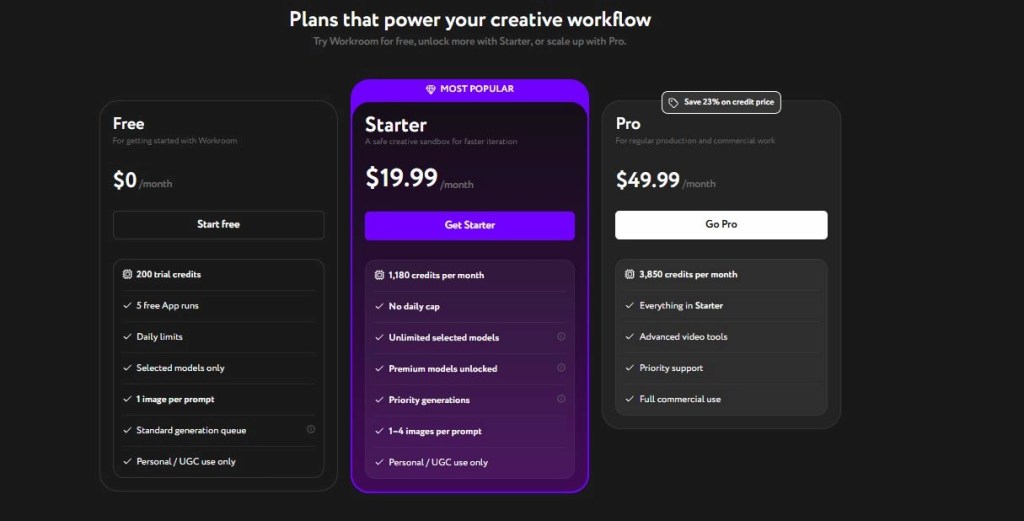
That commercial-use permission shouldn’t be confused with an automatic transfer of an upstream vendor’s enterprise indemnification or data-processing guarantees.
When generating through Everypixel, review the applicable platform agreement and any model-specific restrictions relevant to the project.
For confidential client footage or projects requiring IP indemnification, the exact contractual protections should be confirmed before production.
Do You Need to Label AI-Generated Video?
Disclosure requirements depend on the model license, the type of content, and where it will be distributed.
Two technical systems commonly appear in AI video workflows.
SynthID is Google’s invisible watermarking technology. It embeds information that can help supported detection systems identify AI-generated content.
C2PA Content Credentials record provenance information about the creation or modification of digital assets. They can include cryptographically protected records, but they don’t guarantee that the underlying content is accurate or free of copyright issues.
What Does the EU AI Act Require?
Article 50 of the EU AI Act introduced transparency obligations applying from August 2, 2026.
Providers of certain AI systems have obligations concerning machine-readable marking of synthetic content. A transitional period applies to some previously marketed systems.
Deployers must disclose AI-generated or manipulated content that qualifies as a deepfake, subject to the regulation’s scope and exceptions.
Not every AI-assisted video automatically qualifies as a deepfake. The requirements depend on whether the content fits the legal definition and how it’s used.
China introduced separate AI-content labeling measures effective September 1, 2025.
For commercial distribution, check the relevant model license, applicable law, and publishing-platform rules. The European Commission’s transparency guidance provides a useful starting point for understanding EU requirements.
Checklist: Before Delivering AI Video to a Client
Before publishing or delivering a commercial AI video:
- Confirm commercial-use rights. Check the exact plan, platform, and access route.
- Review training permissions. Don’t upload confidential client footage without understanding how the provider may use it.
- Check indemnification. If the client requires protection against IP claims, verify the actual agreement and its exclusions.
- Check territorial and revenue restrictions. This is particularly important for MiniMax H3 and LTX open weights.
- Preserve required watermarks and provenance metadata. Test the final export rather than assuming editing software keeps them intact.
- Apply required disclosures. Follow model-license conditions, applicable law, and publishing-platform policies.
- Keep a production record. Document the model, version, access route, relevant license, and generation date.
If you’re producing AI content for commercial campaigns, explore the models available in Everypixel and choose a plan appropriate for your intended use.
The Bottom Line
Commercial-use permission is only one part of choosing an AI video generator for client work.
Google Cloud and Runway Enterprise provide contractual protections worth considering for sensitive projects. Luma’s API and Enterprise terms offer stronger training restrictions than its standard service agreement. Wan 2.2 provides flexible commercial self-hosting under Apache 2.0.
Meanwhile, MiniMax H3 and LTX show why open weights don’t necessarily mean unrestricted commercial use.
Before committing to a model, check not only whether you can publish its outputs, but also what rights the provider retains, what restrictions apply, and who bears the risk if something goes wrong.
Related reading: Can You Use AI-Generated Images Commercially? covers the same questions for 14 image generators, and New Wave in AI Video Generation compares Kling 3.0, LTX Video 2.3 and Runway Gen 4.5.
Disclaimer: This article summarizes publicly available licensing documents reviewed October, 2026. It isn’t legal advice. Contractual terms may change, and enterprise agreements may differ from public policies.
FAQ
Can I use AI-generated videos commercially?
Yes. Most major AI video generators permit commercial use under eligible subscriptions, API agreements, or open-weights licenses. However, commercial permission doesn’t automatically grant copyright exclusivity or IP indemnification. Training rights, territorial limits, revenue thresholds and disclosure rules differ by provider, so check the exact plan and access route before delivering footage to a client.
Can I use Kling AI commercially?
Yes, under Kling’s paid membership terms. Free users don’t receive the same commercial rights without written permission. Kling’s standard terms also allow certain uses of customer content for AI training, with an email-based revocation mechanism, and the consumer terms include no IP indemnification. Confirm the effect of revocation with Kling before uploading NDA-covered footage.
Which AI video generators offer IP indemnification?
Eligible Google Cloud services, Runway Enterprise, qualifying Adobe agreements, Luma Enterprise, and MiniMax API terms provide different forms of IP protection.
Coverage varies and may exclude claims involving user-provided material, trademarks, modifications, or other circumstances. Kling’s consumer terms, Wan open weights, LTX and Moonvalley’s public terms don’t include output indemnification, so ask the provider for written confirmation if your client requires it.
Does Runway train on uploaded video?
Under its standard terms, yes. Runway’s standard terms permit training on inputs and outputs, and they don’t identify a general opt-out. Runway Enterprise prohibits using Customer Content as training data under its enterprise agreement, so confidential footage is better handled under that contract.
Can I use MiniMax H3 commercially in the US or EU?
Not under its standard open-weights community license without separate authorization. That agreement excludes the US, EU, UK, and South Korea, including certain uses of outputs. The hosted MiniMax API has different terms and doesn’t impose the same territorial exclusion, but it allows the provider to use inputs and outputs for service development.
Do I have to disclose that a video was generated with AI?
Sometimes. Specific model licenses, such as LTX’s, require disclosure. Regional laws, including the EU AI Act, and publishing-platform rules may impose additional labeling obligations, particularly for synthetic content that qualifies as a deepfake. Check the model license, the law where you distribute, and the platform’s policy.